Best Accounting Software for Small Business in Bangladesh
From spreadsheets to local software to international platforms — here is an honest look at accounting software options for small businesses in Bangladesh, and what actually works.

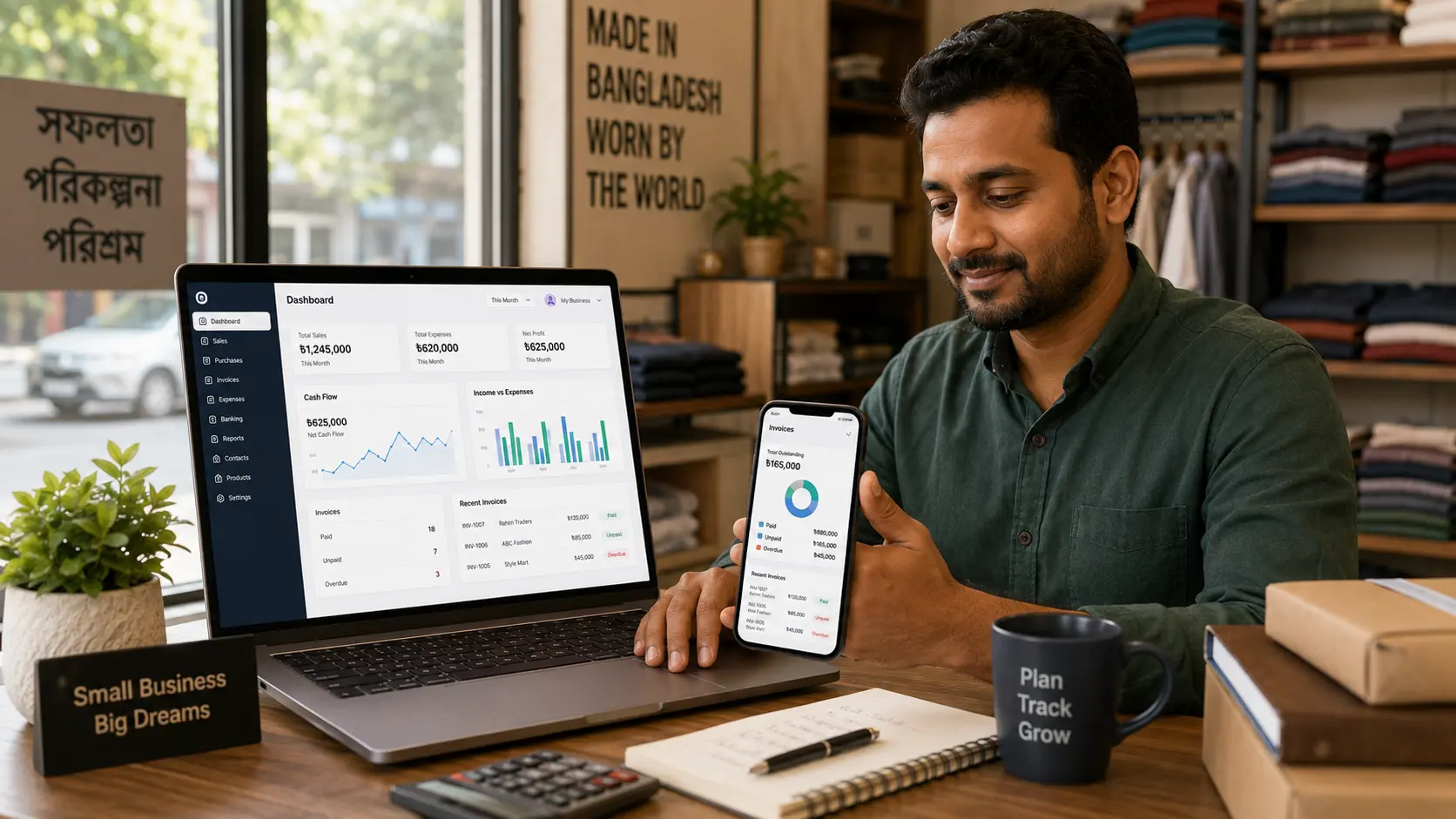
Small businesses in Bangladesh — retail shops, trading companies, service businesses, manufacturers, agencies, and growing startups — overwhelmingly manage their finances in one of three ways: a physical ledger book (খাতা), an Excel spreadsheet, or nothing organized at all beyond bank statements and memory.
Dedicated accounting software exists, but adoption among Bangladeshi SMBs remains low — not because business owners do not see the value, but because the available options have historically been a poor fit. International platforms are priced and designed for Western markets. Local desktop software is often outdated, difficult to use, and not cloud-based. And the perception persists that accounting software is something for large companies with finance departments, not a small trading business or a local service provider.
This is changing. Cloud accounting adoption among Bangladeshi small businesses is accelerating — driven by growing digital payment adoption (bKash, Nagad), increased exposure to international business practices, and a new generation of business owners who expect software to be as accessible as the apps they use personally.
This guide looks honestly at the accounting software options available to small businesses in Bangladesh, what each one offers, where they fall short, and what actually matters when choosing.
Why Small Businesses in Bangladesh Need Accounting Software
Before comparing platforms, it is worth being clear about what proper accounting software actually changes for a small business — because for many Bangladeshi business owners, the current system (a ledger book, a notebook, or memory) "works" in the sense that the business continues operating. The question is what it costs in ways that are not immediately visible.
Knowing your actual profit — not just your cash position
A business owner checking their bank balance or cash drawer knows how much money they have right now. They do not necessarily know whether the business is profitable — because profit depends on revenue, costs, and timing in ways that a cash balance does not show.
A business that received a large customer payment this week may have a healthy bank balance while actually operating at a loss once all costs are accounted for. Proper accounting — even basic Profit & Loss tracking — reveals this. A ledger book or memory does not.
Tracking who owes you money — and following up
Many Bangladeshi small businesses extend informal credit to regular customers — a shop allows a trusted customer to pay later, a supplier extends payment terms to a business client. Without a system to track outstanding amounts by customer, these informal credit arrangements become difficult to manage as the business grows. Money owed gets forgotten. Follow-up does not happen. Cash that should have arrived does not.
Separating business and personal finances
A very common pattern among Bangladeshi small business owners — particularly sole proprietors — is using the same bank account and cash for business and personal expenses. This makes it impossible to know the business's actual financial position, complicates any future loan application, and creates significant difficulty at tax time.
Preparing for VAT registration and compliance
As a business grows past the VAT registration threshold, organized financial records become a legal requirement, not just a good practice. Businesses that have been managing finances informally face a difficult transition when VAT registration becomes mandatory — proper accounting from an earlier stage makes this transition far easier.
Making informed decisions about pricing, costs, and growth
Should you raise prices? Can you afford to hire? Is a particular product line profitable? These questions require financial data — revenue and cost breakdowns by category, by product, by period. A ledger book that records transactions chronologically does not answer these questions without significant manual analysis.
The Options Available to Bangladeshi Small Businesses
Physical Ledger Books (খাতা)
The traditional approach — and still the most common among smaller traders and shops in Bangladesh.
What it offers: Zero cost, no technology required, familiar to generations of business owners and accountants.
Where it falls short:
- No automatic calculations — totals, balances, and summaries are all manual
- No reports — understanding profitability requires manual analysis across potentially years of entries
- Physical risk — loss, damage, fire, or simply illegible handwriting over time
- No backup — a lost or damaged ledger means lost financial history
- Difficult to share with an accountant remotely — requires physical access to the book
- Cannot integrate with digital payments (bKash, Nagad, card payments) — these require separate manual recording
Verdict: Workable for very small, simple operations with low transaction volume — but a significant limitation as a business grows, takes on digital payments, or needs to demonstrate financial records for loans, VAT registration, or investment.
Excel / Google Sheets
A step up from physical ledgers — many growing Bangladeshi businesses use spreadsheets to track income, expenses, and basic reports.
What it offers: Familiar tool, flexible, free (Google Sheets) or low-cost (Excel), can produce basic charts and summaries with effort.
Where it falls short:
- No automatic invoice generation — invoices are typically separate Word or PDF documents not connected to the financial records
- No automatic bank or mobile financial service (bKash/Nagad) syncing — every transaction is manually entered
- Formula errors and version control issues — multiple people editing, accidental overwrites, broken formulas
- No payment reminder automation — outstanding customer balances must be tracked and followed up manually
- Reports require manual building — there is no "Profit & Loss" button, just whatever formulas have been built
- Does not scale well — what works for 20 transactions a month becomes unmanageable at 200
Verdict: A reasonable interim step for businesses transitioning away from pure ledger books, but the manual effort and error risk become significant as transaction volume grows — and the lack of integrated invoicing means financial records and customer billing remain disconnected.
Local Desktop Accounting Software
Several locally developed desktop accounting packages are used by Bangladeshi businesses — typically installed on a single computer, often used primarily by an accountant or bookkeeper rather than the business owner directly.
What it offers: Familiarity within the local accounting community, often configured for Bangladeshi VAT requirements specifically, one-time or lower recurring cost than international SaaS.
Where it falls short:
- Desktop-based — accessible only from the computer it is installed on, no remote access for the business owner
- Often requires an accountant or trained operator to use effectively — not designed for the business owner to interact with directly
- Limited or no integration with online payments, e-commerce, or modern banking
- Update and support quality varies significantly between vendors
- Data is typically stored locally — backup and security depend entirely on the business's own practices
Verdict: Functional for businesses that primarily need VAT-compliant records prepared by an accountant and do not need the business owner to interact with the system directly. Limited for business owners who want visibility into their own numbers without going through an intermediary.
International Cloud Platforms (QuickBooks, Xero)
Global cloud accounting platforms are technically accessible to Bangladeshi businesses — but were not designed with this market in mind.
Where they fall short for Bangladesh:
- Pricing in USD/GBP represents a significant cost relative to typical Bangladeshi SMB revenue — particularly once add-ons for additional users or features are included
- Bank feed integrations do not support Bangladeshi banks — a core feature of these platforms (automatic bank transaction import) does not work as designed
- VAT configuration is built around UK/EU/US tax systems — not Bangladesh NBR requirements
- Mobile financial services (bKash, Nagad) — an essential part of how many Bangladeshi businesses transact — are not supported by any bank feed integration
- Customer support operates in time zones and languages not optimized for Bangladeshi users
What they offer: Comprehensive accounting depth, strong reputation, useful if the business has international operations or investors who expect a recognized platform.
Verdict: Workable for Bangladeshi businesses with significant international operations, foreign investors who expect a specific platform, or businesses large enough that the cost is proportionally reasonable. For typical Bangladeshi SMBs, the core bank integration and VAT configuration gaps mean much of the platform's value is not realized.
Accoru
Accoru is a cloud accounting platform built around principles that happen to address several gaps relevant to Bangladeshi small businesses — even though it was not built exclusively for this market.
Where it fits the Bangladesh small business context:
Cloud-based with no installation required. The business owner can access financial data from anywhere — a phone browser, a laptop, or a desktop — without depending on a single computer or an accountant's availability.
Designed for business owners, not just accountants. The interface uses plain language and logical workflows rather than accounting terminology — important for Bangladeshi business owners who want direct visibility into their numbers without an intermediary.
Flat, predictable pricing with no per-user fees. A small business with multiple family members or staff accessing the system pays the same flat rate — relevant for the common Bangladeshi small business structure where multiple people (owner, family member, bookkeeper) may need access.
Multi-currency included. Relevant for the growing number of Bangladeshi small businesses with import/export operations, international suppliers, or e-commerce sales to international customers.
Manual transaction entry without penalty. Since automatic bank feeds for Bangladeshi banks (and mobile financial services like bKash and Nagad) are not available on any major platform, Accoru's straightforward manual entry and CSV import options mean the absence of automatic bank sync is not a significant barrier — entering transactions manually is fast and the rest of the platform (invoicing, reports, reconciliation) works fully regardless.
Professional invoicing with online payment. For Bangladeshi businesses serving international clients or accepting card payments, professional invoices with Stripe and PayPal integration provide a payment experience that local informal invoicing cannot match.
Where it has gaps:
- No specific NBR VAT return format — Accoru produces tax summary reports (income, expenses, tax collected) but does not generate Bangladesh-specific VAT return forms
- No bKash or Nagad integration — transactions from mobile financial services need to be entered manually
- No local Bangladesh customer support — support is in English
Verdict: For Bangladeshi small businesses that want a cloud-based system the owner can access directly, with professional invoicing and complete financial reports, Accoru addresses the core need at a flat, predictable cost — with the understanding that VAT-specific filing forms and local payment method integration will need to be handled alongside the software rather than within it.
What to Look for When Choosing Accounting Software in Bangladesh
Given the realities of the Bangladesh market, here is the practical checklist.
Cloud-based, not desktop-only
The business owner should be able to check their numbers from a phone, without depending on a specific computer or a third party's availability.
Owner-accessible, not accountant-only
If the system requires an accountant to operate, the business owner remains dependent on that relationship for basic visibility into their own numbers. A system the owner can navigate directly — even if an accountant also has access — gives the business genuine financial visibility.
Flat pricing, not per-user or tiered
For businesses with multiple people needing access — common in Bangladeshi family businesses — per-user pricing compounds quickly. Flat pricing that includes team access is significantly more practical.
Professional invoicing built in
Whether serving local or international customers, professional invoices with clear payment terms — and online payment acceptance for businesses that can use it — improve both cash flow and professional perception.
Acceptance that manual entry is normal
Given the absence of bKash, Nagad, and Bangladeshi bank integrations across virtually all platforms, choose software where manual transaction entry is fast and well-designed — not an afterthought bolted onto a system built around automatic bank feeds.
Multi-currency if there is any international dimension
Import, export, international clients, or overseas remittance — any of these make multi-currency support relevant, and it should be included without requiring an expensive upgrade.
Reports that make sense without accounting training
Profit & Loss, cash flow, and outstanding customer balances should be understandable to a business owner without an accounting background — not just technically accurate but presented in a way that supports decision-making.
Transitioning From a Ledger Book or Spreadsheet to Accounting Software
For a Bangladeshi small business moving from informal record-keeping to proper accounting software, here is a practical transition approach.
Step 01 — Choose a clean starting point
The start of a new financial year, or the start of a new month, is the cleanest transition point. Rather than trying to enter years of historical ledger entries, start recording from a specific date forward and keep the historical ledger as a reference if needed.
Step 02 — Record opening balances
Enter the current state as of the start date — cash on hand, bank balance, amounts owed to the business by customers, amounts the business owes to suppliers. This gives the new system an accurate starting point.
Step 03 — Set up customer and supplier records
For regular customers — particularly those with informal credit arrangements — set up customer profiles. This immediately makes outstanding balances visible and trackable in a way a ledger book makes difficult.
Step 04 — Start invoicing through the system
Rather than writing invoices separately and recording them in a ledger afterward, create invoices directly in the accounting software. This connects the invoice to the financial record automatically — no separate recording step.
Step 05 — Record expenses as they happen
Build the habit of recording expenses — even small cash purchases — at the time they occur or at the end of each day. A five-minute daily habit is far more manageable than reconstructing a month of expenses from memory and receipts.
Step 06 — Review reports monthly
Once a month, review the Profit & Loss report. For many Bangladeshi small business owners, this is the first time they see their business's profitability presented clearly — separate from their cash position — and it often changes decisions about pricing, spending, and priorities.
Addressing the VAT Question
As a Bangladeshi business approaches or exceeds the VAT registration threshold, the relationship between accounting software and VAT compliance becomes important.
What accounting software can do:
- Track sales and the VAT charged on them
- Track purchases and the VAT paid on them
- Produce a summary report of VAT collected versus VAT paid for any period
What most accounting software — including Accoru — does not do specifically for Bangladesh:
- Generate the specific NBR VAT return form (Mushak forms) in the exact format required for filing
- Submit returns directly to the NBR online portal
The practical approach: Use accounting software to maintain accurate, organized records of sales, purchases, and VAT amounts throughout the period. At filing time, this organized data is provided to an accountant or used directly to complete the NBR VAT return forms — a significantly faster and more accurate process than compiling the same information from a ledger book or scattered spreadsheets.
For a detailed look at VAT obligations for Bangladeshi small businesses, see our guide on VAT and tax accounting for small business in Bangladesh.
A Realistic Picture of Adoption
It is worth being honest: accounting software adoption among small businesses in Bangladesh remains lower than in many other markets, and the businesses that have adopted cloud accounting tend to be newer, younger-founder-led, or have some international dimension to their operations (export, international clients, or foreign investment).
This is changing for several reasons:
Digital payment growth. As more transactions happen through bKash, Nagad, and card payments rather than cash, the natural recording point shifts from a ledger book toward a digital record — and proper accounting software is a natural extension of that shift.
Generational change in business ownership. Younger business owners — often with exposure to international business practices through education, freelancing, or e-commerce — are more likely to expect and adopt cloud software as a default rather than an unusual choice.
Loan and investment requirements. Banks and investors increasingly expect organized financial records as part of any funding application. Businesses that have maintained proper accounting records have a meaningfully easier path to financing than those that need to reconstruct records under time pressure.
Reduced cost of cloud software. Flat-rate, affordable cloud accounting — as opposed to expensive enterprise software — makes proper accounting accessible to businesses that would never have considered it cost-effective even five years ago.
Summary
Small businesses in Bangladesh have historically been underserved by accounting software — caught between informal ledger-based systems that do not scale, and international platforms built for markets with different banking infrastructure, tax systems, and pricing expectations.
The realistic picture:
- Ledger books work for the smallest, simplest operations but create real limitations as businesses grow, take on digital payments, or need financing
- Spreadsheets are a reasonable interim step but become error-prone and disconnected from invoicing as volume grows
- Local desktop software often serves accountants well but limits direct owner visibility
- International platforms carry cost and integration gaps — particularly around Bangladeshi banking and VAT — that limit their practical value
- Accoru offers cloud-based, owner-accessible accounting with flat pricing, professional invoicing, and multi-currency support — with the understanding that VAT filing forms and local payment method recording remain manual steps alongside the software
For Bangladeshi small business owners ready to move beyond informal record-keeping, the right choice depends on whether the priority is direct owner visibility (favoring cloud, owner-accessible platforms) or accountant-managed VAT compliance specifically (where local desktop software with NBR-specific configuration may remain relevant alongside any cloud system used for day-to-day operations).
Frequently Asked Questions
Q: Can accounting software replace my accountant in Bangladesh? A: No — and it should not try to. Accounting software organizes your financial records, generates invoices, and produces reports. Your accountant uses that organized data to prepare VAT returns, income tax filings, and provide advisory guidance specific to Bangladeshi regulations. Good accounting software makes your accountant's work faster and more accurate — it does not replace the relationship.
Q: How do I record bKash and Nagad transactions in accounting software? A: Most accounting platforms, including Accoru, do not have direct integration with Bangladeshi mobile financial services. Transactions need to be entered manually — recorded as income or expenses with bKash/Nagad noted as the payment method. Both bKash and Nagad provide transaction history in their apps, which can be referenced when entering records, typically as part of a regular (e.g., weekly) update routine.
Q: Is cloud accounting software safe for a Bangladeshi business — what about data security? A: Reputable cloud accounting platforms use encryption, secure data centers, and access controls that meet international security standards — generally more secure than a single computer with local desktop software or a physical ledger book vulnerable to loss or damage. Confirm the platform's data handling practices, but cloud storage is not inherently less secure than local storage — in most respects it is more secure.
Q: My business does not have any international clients — is multi-currency still relevant? A: If all transactions are in BDT with no foreign suppliers, customers, or remittance involved, multi-currency is not an immediate priority. However, many businesses that start purely domestic later take on an international supplier, export opportunity, or online sales channel reaching international customers — having multi-currency available without needing to switch platforms later is a practical advantage.
Q: What is the realistic time investment to switch from a ledger book to accounting software? A: Initial setup — business details, opening balances, customer and supplier records — typically takes one to two hours for a small business. After that, the ongoing time investment is largely replacing time currently spent on the ledger book — recording transactions takes a similar amount of time, but produces far more usable output (invoices, reports, customer balance tracking) for the same effort.
Q: Should I choose software based on what my accountant uses? A: It depends on your relationship. If your accountant manages your books entirely and you have no need for direct visibility, using their preferred platform may be simplest. If you want direct ownership of your financial data and the ability to check your numbers yourself, choose a platform that works for you as the business owner — and share access with your accountant, who can typically work within most cloud platforms regardless of their personal preference.
Accoru gives Bangladeshi small business owners cloud-based accounting they can access directly — professional invoicing, expense tracking, financial reports, and multi-currency support — at a flat rate with no per-user fees.