Accounting Software for E-commerce — What Store Owners Actually Need
E-commerce accounting is messier than service business accounting. Multiple payment processors, platform fees, refunds, and sales tax across states — here is what actually handles it.

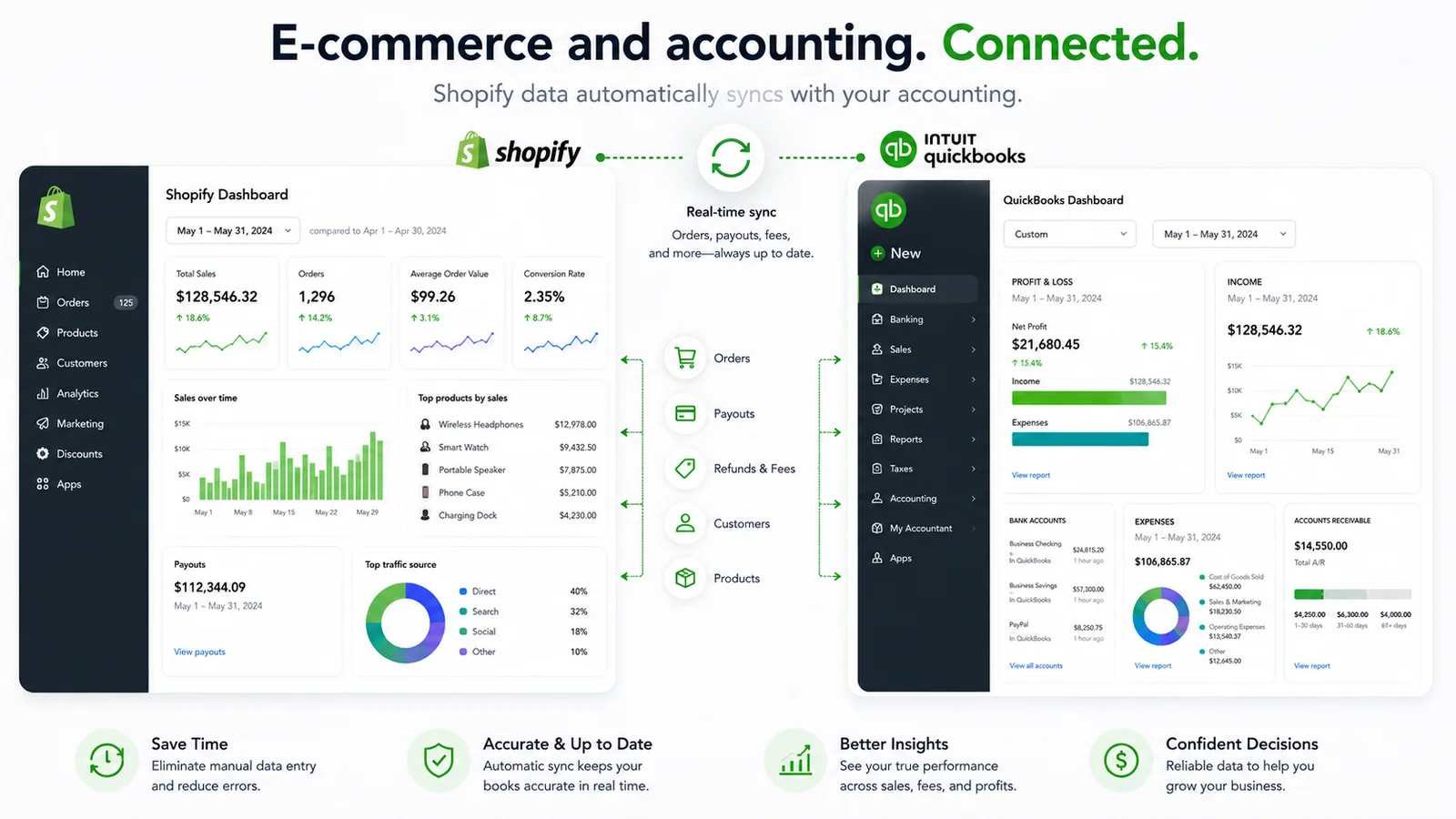
Running an e-commerce business creates a specific set of accounting challenges that a general-purpose accounting guide does not fully address — and that most accounting software handles inconsistently.
The volume of transactions is higher than most service businesses. Revenue comes from multiple channels — your own store, marketplaces, wholesale orders. Payment is processed through multiple platforms — Stripe, PayPal, Shopify Payments, Amazon Payments — each with its own fee structure and payout schedule. Refunds are more frequent. Returns affect inventory. Sales tax applies across multiple jurisdictions. And the timing difference between when an order is placed, when it is fulfilled, when it is paid out by the platform, and when it hits your bank account creates reconciliation complexity that trips up even experienced business owners.
Choosing the wrong accounting software — or using the right software incorrectly — means inaccurate financial records, incorrect tax calculations, and a painful year-end where your accountant has to reconstruct months of messy transaction history.
This guide covers what e-commerce businesses specifically need from accounting software, how the main platforms handle those needs, and what to look for when making the decision.
Why E-commerce Accounting Is Different
Before getting into platform comparisons, it is worth understanding exactly what makes e-commerce accounting more complex than service business accounting — because the specific complexities determine which platform features actually matter.
High transaction volume
A service business might invoice 20–30 clients per month. An e-commerce business might process 200–2,000 orders. The volume difference means that manual transaction entry is completely impractical — automatic sync from the e-commerce platform to the accounting system is not a nice-to-have, it is essential.
Platform fees and payment processor fees
Every sale processed through Shopify, PayPal, Stripe, or Amazon incurs fees — transaction fees, payment processing fees, platform fees, currency conversion fees. These fees reduce the actual revenue received from each sale and must be recorded accurately.
The challenge is that platform fees are often deducted before payout — you receive net revenue rather than gross revenue minus separate fee invoices. Accounting for this correctly requires understanding how each platform structures its payouts and recording both the gross revenue and the fees as separate line items.
Payout timing and reconciliation
E-commerce platforms typically pay out on a schedule — daily, weekly, or rolling two-day basis — rather than immediately on each sale. This means the payout amount does not correspond to any single order or set of orders — it corresponds to a rolling window of sales minus fees and refunds.
Reconciling payout amounts in your bank account to the individual orders and fees in your e-commerce platform is one of the most complex aspects of e-commerce bookkeeping. Without proper tools and processes, it leads to reconciliation headaches where the bank balance and the accounting records cannot be aligned.
Returns and refunds
E-commerce businesses have higher refund rates than most service businesses. Each refund must be recorded correctly — reversing the original revenue, restoring inventory (if tracked), and accounting for any fees that were charged on the original transaction and not refunded by the payment processor.
Inventory management
Product businesses need to track inventory — the cost of goods sold for each product sold, the current stock level, and the value of unsold inventory on the balance sheet. Service businesses do not have this complexity. E-commerce businesses do — and the accounting treatment of inventory directly affects profitability calculations.
Sales tax across multiple jurisdictions
In the United States, e-commerce businesses may have sales tax nexus in multiple states — creating an obligation to collect and remit sales tax in each state where nexus exists. Post-Wayfair, economic nexus thresholds mean that businesses selling above a certain volume into a state may have tax obligations there regardless of physical presence.
Managing sales tax obligations across multiple jurisdictions — calculating the correct rate for each transaction, collecting it, and remitting it — is one of the most complex compliance tasks for e-commerce businesses.
Multi-currency for international sales
E-commerce businesses selling internationally deal with multiple currencies — accepting payment in the customer's currency, being paid out by the platform in one currency, and reporting in their home currency. Each currency conversion creates a potential gain or loss that must be tracked.
What E-commerce Businesses Actually Need From Accounting Software
Given these specific complexities, here are the features that genuinely matter for e-commerce accounting — as opposed to the generic feature lists that apply to all businesses.
Native e-commerce platform integration
This is the most critical feature. Your accounting software must connect directly to your e-commerce platform — Shopify, WooCommerce, Amazon, Etsy, or wherever you sell — and sync transactions automatically.
A good e-commerce integration does more than import orders as revenue. It imports:
- Gross order revenue
- Platform fees and transaction fees (as expenses)
- Refunds and returns
- Payout amounts and timing
- Tax collected
Without a native integration, you are either entering transactions manually (impractical at scale) or importing CSV exports periodically (time-consuming and prone to gaps).
Correct revenue recognition
There are different approaches to when e-commerce revenue should be recognized — at the time of order placement, at the time of shipment, at the time of payment, or at the time of payout from the platform.
The accounting approach matters for financial statement accuracy. Cash basis businesses typically recognize revenue when payout is received. Accrual basis businesses recognize it when the order is placed or fulfilled.
Your accounting software needs to handle the revenue recognition approach correctly for your situation — and the e-commerce integration needs to support that approach.
Payout reconciliation
The ability to match platform payouts in your bank account to the underlying orders, fees, and refunds in your accounting system is essential for clean books. This is more complex than standard bank reconciliation — a single payout from Shopify represents many orders, minus many fees, minus any refunds from that payout period.
Good accounting software for e-commerce makes this reconciliation manageable — either by automating the matching or by providing clear tools for working through the complexity.
Inventory tracking
For businesses selling physical products, inventory tracking — cost of goods sold, current stock levels, inventory valuation — needs to be handled correctly. The accounting treatment of inventory directly affects your gross profit calculation and your balance sheet.
Dedicated inventory management software may be required for complex inventory situations. But for simpler product businesses, accounting software with basic inventory tracking capability is sufficient.
Sales tax management
At minimum, your accounting software needs to track sales tax collected on each transaction and produce a clear sales tax report by jurisdiction. For businesses with complex multi-state obligations, dedicated sales tax software — integrated with your accounting platform — may be necessary.
Multi-currency handling
If you sell internationally, multi-currency support is essential. Your accounting software needs to handle transactions in multiple currencies, apply exchange rates correctly, track currency gains and losses, and report in your home currency.
High transaction volume performance
A platform that handles 20 transactions per month without issue may struggle with 2,000. The accounting software you choose needs to handle your actual transaction volume without becoming slow, unreliable, or difficult to reconcile.
Platform Comparisons — E-commerce Specific
QuickBooks Online
QuickBooks is widely used by e-commerce businesses and has reasonable e-commerce accounting capability — but the quality of the experience depends heavily on the integrations you use.
E-commerce strengths:
- Strong Shopify integration via A2X or native Shopify connection
- Inventory management on Plus and above
- Comprehensive financial reporting
- Sales tax tracking
- Multi-currency on Plus and above
- Large integration ecosystem — most e-commerce platforms have QuickBooks connectors
E-commerce limitations:
- Native Shopify integration is less sophisticated than third-party solutions like A2X — many e-commerce accountants recommend using A2X as a middleware layer between Shopify and QuickBooks rather than the native connection
- Inventory management requires Plus — adding to the cost
- Multi-currency requires Plus
- The complexity of QuickBooks can make e-commerce reconciliation more difficult for non-accountants
Best for e-commerce when: You have an accountant managing your books, you need sophisticated inventory management, or you require the broadest possible integration ecosystem.
Xero
Xero has strong e-commerce accounting capability and is the preferred platform for many e-commerce accountants — particularly in the UK and Australia.
E-commerce strengths:
- Strong bank reconciliation workflow — well-suited to high transaction volume
- Good Shopify and WooCommerce integrations
- A2X integration works well with Xero
- Inventory tracking on most plans
- Multi-currency on Premium plan
- Clean interface for reconciliation workflows
E-commerce limitations:
- Multi-currency requires Premium — an additional cost
- The Starter plan's invoice and bill limits make it unsuitable for most e-commerce businesses from day one
- Less US accountant familiarity than QuickBooks
Best for e-commerce when: You are in the UK or Australia where Xero has strong accountant adoption, you have significant transaction volume that benefits from Xero's reconciliation workflow, or you work with an accountant who prefers Xero.
QuickBooks Self-Employed
Not suitable for most e-commerce businesses. The platform is too limited — no proper inventory management, no robust sales tax tracking, limited reporting, and a ceiling that most product businesses reach quickly. Avoid for e-commerce.
Wave
Wave's free model is appealing but has significant limitations for e-commerce:
E-commerce limitations:
- No dedicated Shopify or WooCommerce native integration
- No multi-currency support
- Limited inventory tracking
- Payment processing fees that accumulate at e-commerce transaction volumes
- No automatic payment reminders (less relevant for e-commerce but still a limitation)
- Basic reconciliation tools not well-suited to high transaction volume
Wave is not a strong choice for most e-commerce businesses beyond the very smallest operations. The transaction volume, multi-currency needs, and integration requirements that e-commerce creates are areas where Wave's free model reaches its ceiling quickly.
Accoru
Accoru offers native integration with Shopify and WooCommerce — syncing sales, refunds, and platform fees automatically into the accounting records.
E-commerce strengths:
- Native Shopify integration — orders, refunds, and fees sync automatically
- Native WooCommerce integration
- Multi-currency support across 150+ currencies — included on every plan
- Bank reconciliation with automatic transaction matching
- Complete financial reports — P&L, balance sheet, cash flow
- Expense tracking with bank sync
- Flat pricing with no per-user fees — team access without cost escalation
E-commerce limitations:
- Inventory management is basic at current stage — complex inventory requirements may need supplementary software
- Dedicated e-commerce reconciliation tools (like A2X provides) are not currently a separate offering
- Payroll is not included
Best for e-commerce when: You run a Shopify or WooCommerce store with moderate complexity, you have international customers and need multi-currency support included in the base price, and you want complete accounting at flat pricing without per-user fees as your team grows.
The A2X Question
A2X is a middleware tool specifically designed for e-commerce accounting — it sits between your e-commerce platform (Shopify, Amazon, Etsy, eBay) and your accounting software, aggregating transactions into clean summary journal entries that match your platform payouts.
Many e-commerce accountants recommend A2X regardless of which accounting platform you use — because it solves the payout reconciliation problem more elegantly than any accounting platform's native integration currently does.
How A2X works:
- Connects to your e-commerce platform
- Aggregates all transactions within each payout period
- Creates a single settlement journal entry per payout — matching exactly to the payout amount in your bank
- Posts the entry to your accounting software automatically
The result is that reconciling your e-commerce bank account becomes straightforward — each payout in your bank matches exactly to one journal entry in your accounting software.
The trade-off: A2X costs extra — it is a paid subscription on top of your accounting software subscription. For businesses with high transaction volume or multiple selling channels, the time and accuracy benefit justifies the cost. For smaller e-commerce businesses with simple operations, the native integrations in most accounting platforms are sufficient.
Whether to use A2X depends on your transaction volume, your selling channels, and how much time you currently spend on e-commerce reconciliation.
Sales Tax — The E-commerce Compliance Challenge
Sales tax is one of the most complex compliance issues for e-commerce businesses — particularly in the United States, where each state has its own tax rates, rules, and filing requirements.
Post-Wayfair, e-commerce businesses have economic nexus obligations in states where they exceed certain sales volume or transaction thresholds — regardless of whether they have any physical presence in that state.
What accounting software handles: Most accounting platforms can track sales tax collected on transactions and produce a tax liability report by jurisdiction. This tells you how much you have collected and where.
What accounting software does not fully handle: Determining your nexus obligations across all states, staying current with changing rates and rules, filing returns in multiple states on different schedules — this is beyond what accounting software alone manages.
Dedicated sales tax tools: For e-commerce businesses with multi-state obligations, dedicated sales tax tools — TaxJar, Avalara — integrate with e-commerce platforms to automate tax calculation, tracking, and filing. These tools integrate with most major accounting platforms and are widely used by e-commerce accountants.
If you are selling into multiple US states and are uncertain about your sales tax obligations, a conversation with a tax professional who specializes in e-commerce is worth the investment before the obligation compounds.
Inventory Accounting — The Basics E-commerce Businesses Need to Understand
Inventory accounting affects your financial statements in ways that non-product businesses do not encounter. Understanding the basics helps you choose the right accounting approach and avoid common mistakes.
Cost of Goods Sold
When you sell a product, the cost of that product — what you paid to manufacture or purchase it — is recorded as Cost of Goods Sold (COGS) on your Profit & Loss statement. COGS reduces your gross profit.
If you sold a product for $50 and it cost you $20 to produce or purchase, your gross profit on that sale is $30 — not $50.
Getting COGS right requires knowing the cost of each product sold and recording it correctly at the time of sale.
Inventory Valuation
Unsold inventory has value — it is an asset on your balance sheet. The accounting method you use to value that inventory — FIFO (first in, first out), LIFO (last in, first out), or weighted average cost — affects both your balance sheet value and your COGS calculation.
Most small e-commerce businesses use FIFO — the first items purchased are assumed to be the first items sold. This is the most straightforward method and widely accepted.
When Inventory Complexity Requires Dedicated Software
For e-commerce businesses with:
- Many SKUs
- Bundles and kits (multiple products sold as one)
- Multiple warehouses or fulfillment locations
- Manufacturing or assembly
- Significant returns and restocking
Standard accounting software inventory tracking reaches its limits quickly. Dedicated inventory management software — integrated with your accounting platform — handles these complexities more effectively.
Choosing the Right Platform — A Decision Framework for E-commerce
If you run a Shopify store with moderate complexity:
Shopify's integration quality is a primary consideration. Most major accounting platforms have Shopify integrations — but the quality varies. Test the specific integration for your platform before committing. Accoru, QuickBooks, and Xero all offer functional Shopify integrations. If payout reconciliation is complex, evaluate whether A2X is worth adding.
If you sell on multiple channels (Shopify + Amazon + Etsy):
Multi-channel e-commerce significantly increases accounting complexity. QuickBooks and Xero have the broadest integration ecosystems — covering most major marketplaces. A2X supports multiple channels and is worth evaluating for businesses selling on three or more platforms.
If you sell internationally:
Multi-currency support is non-negotiable. Confirm it is included in the plan you are evaluating — not locked behind a more expensive tier. Accoru includes multi-currency on every plan. QuickBooks and Xero include it on higher plans only.
If you have significant inventory:
Basic inventory tracking is available in most accounting platforms. For complex inventory — many SKUs, manufacturing, multiple warehouses — dedicated inventory software integrated with your accounting platform is a better solution than relying on accounting software inventory features alone.
If sales tax compliance across multiple states is a concern:
Accounting software alone is not sufficient for complex multi-state tax compliance. Budget for a dedicated sales tax tool — TaxJar or Avalara — and consult a tax professional who specializes in e-commerce.
If you are just starting out:
Start with a platform that covers your immediate needs without overcomplicating your setup. A small Shopify store with domestic sales and simple inventory can be managed with most accounting platforms. Build in flexibility to add tools as complexity grows.
The Integration Stack for a Typical E-commerce Business
For context, here is the typical tool stack for a well-run mid-size e-commerce business:
| Layer | Tool Type | Purpose |
|---|---|---|
| E-commerce platform | Shopify / WooCommerce | Orders, products, customers |
| Payment processing | Stripe / Shopify Payments | Payment collection |
| Inventory management | Dedicated tool (if needed) | Stock tracking, orders |
| E-commerce accounting bridge | A2X (if needed) | Payout reconciliation |
| Accounting software | QuickBooks / Xero / Accoru | Books, reports, tax |
| Sales tax | TaxJar / Avalara (if needed) | Multi-state compliance |
Not every e-commerce business needs every layer. A small Shopify store with domestic sales and simple inventory might only need the e-commerce platform, accounting software, and direct integration between them. A multi-channel international seller with complex inventory needs more of the stack.
Match the stack to the complexity of your operation — not to what looks most sophisticated.
Summary
E-commerce accounting has specific requirements that general accounting guides and generic software comparisons do not fully address. The transaction volume, payout reconciliation complexity, inventory accounting, and sales tax obligations of e-commerce businesses require deliberate platform selection and configuration — not just choosing whichever accounting software is most familiar.
The non-negotiables for most e-commerce businesses:
- Native integration with your selling platform — not manual CSV imports
- Correct payout reconciliation capability
- Multi-currency support if you sell internationally
- Sales tax tracking and reporting
- Inventory tracking sufficient for your product complexity
The platforms that handle e-commerce accounting best:
- QuickBooks — Broadest integration ecosystem, strongest for complex inventory, highest cost
- Xero — Strong reconciliation workflow, preferred by e-commerce accountants in UK and ANZ
- Accoru — Native Shopify and WooCommerce integration, multi-currency on every plan, flat pricing
Match the platform to your specific selling channels, transaction volume, and geographic complexity — and supplement with dedicated tools where the accounting software reaches its limits.
Frequently Asked Questions
Q: What accounting software integrates best with Shopify? A: QuickBooks, Xero, and Accoru all offer Shopify integrations. For high transaction volumes or complex reconciliation, many e-commerce accountants recommend using A2X as a middleware layer between Shopify and your accounting software — regardless of which accounting platform you use. A2X creates clean payout-matching journal entries that make bank reconciliation significantly more straightforward.
Q: How do I handle Shopify fees in my accounting? A: Shopify charges transaction fees and platform fees that are typically deducted from payouts rather than invoiced separately. These fees need to be recorded as expenses in your accounting system — either individually or as part of a settlement summary that matches each payout. A2X automates this by creating settlement entries that include gross revenue, fees, and refunds matching each payout amount.
Q: Do I need separate inventory software for my e-commerce store? A: It depends on the complexity of your inventory. Most accounting platforms include basic inventory tracking — suitable for businesses with moderate SKU counts, no manufacturing or assembly, and single-location fulfillment. For more complex inventory situations — many SKUs, kits and bundles, multiple warehouses, manufacturing — dedicated inventory software integrated with your accounting platform typically handles the complexity better.
Q: How do I handle sales tax for my e-commerce business? A: Most accounting platforms track sales tax collected on transactions and produce jurisdiction-level reports. For multi-state compliance in the US — determining nexus, calculating correct rates, filing returns — dedicated sales tax tools like TaxJar or Avalara automate most of the work and integrate with major accounting platforms. Consult a tax professional who specializes in e-commerce if you are uncertain about your multi-state obligations.
Q: Can Wave handle e-commerce accounting? A: Wave has significant limitations for most e-commerce businesses — no native Shopify or WooCommerce integration, no multi-currency support, and basic reconciliation tools that struggle with high transaction volumes. For very small e-commerce businesses with simple domestic operations and minimal card payment volume, Wave's free plan is usable. For most e-commerce businesses with growth ambitions, the limitations are reached quickly.
Q: What is the best accounting method for an e-commerce business — cash or accrual? A: Most growing e-commerce businesses benefit from accrual accounting — it gives a more accurate picture of revenue and profitability by matching income to the period it was earned rather than when cash was received. Cash basis is simpler and may be sufficient for very small e-commerce businesses. Check the requirements in your jurisdiction — some countries require accrual accounting above certain revenue thresholds.
Accoru integrates natively with Shopify and WooCommerce — syncing orders, refunds, and fees automatically into your accounting records, with multi-currency support included on every plan.