Best Accounting Software for Freelancers in Bangladesh
Most accounting software is built for US and UK businesses with no thought for Bangladeshi freelancers — multi-currency, BDT conversion, and local realities. Here is what actually works.

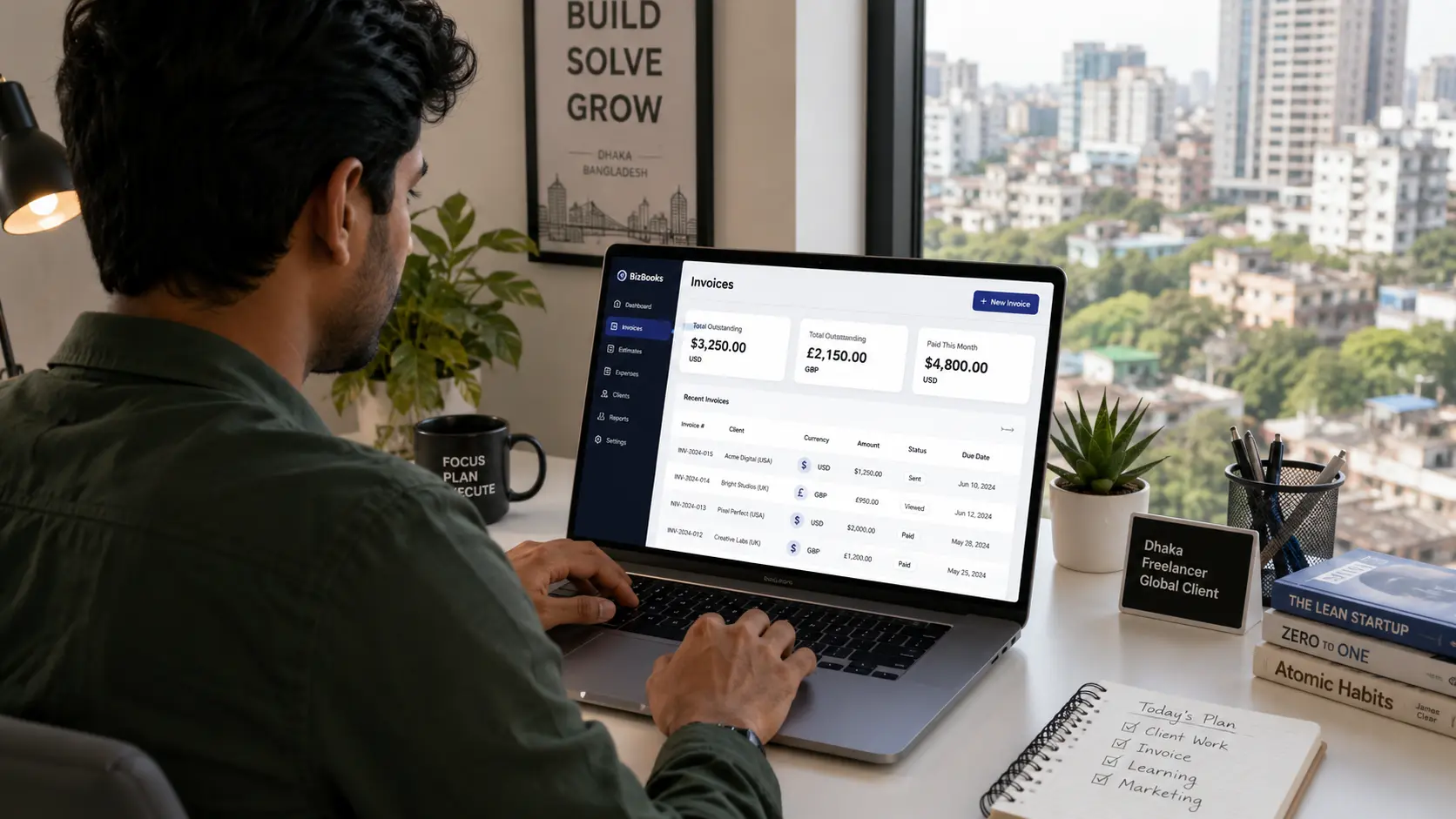
Bangladesh has one of the fastest-growing freelance workforces in the world. Hundreds of thousands of Bangladeshi professionals — developers, designers, writers, marketers, virtual assistants, and consultants — earn income from clients across the US, UK, Europe, Australia, and the Middle East.
And yet the accounting software market has almost entirely ignored this market. Most platforms are built with US tax categories, US bank integrations, and pricing in USD that assumes a US cost of living. None of them are built with Bangladeshi freelancers in mind — receiving payments via Payoneer or Wise, converting USD to BDT, and managing income that crosses borders by default.
This guide looks at what a Bangladeshi freelancer actually needs from accounting software, evaluates the platforms most commonly used, and explains where each one falls short for this specific situation — and where one gets it right.
What Bangladeshi Freelancers Actually Need From Accounting Software
Before comparing platforms, it is worth being specific about what matters for this situation — because the standard "best accounting software" comparison written for a US or UK audience misses several things that are essential here.
Multi-currency support that is not an upgrade
This is the single most important requirement and the one most platforms get wrong. A Bangladeshi freelancer invoicing a US client in USD, a UK client in GBP, and tracking income in BDT for tax purposes needs multi-currency support built into the core product — not locked behind a premium plan that costs significantly more.
Many platforms treat multi-currency as an advanced feature for international businesses. For a Bangladeshi freelancer, it is not advanced — it is the default mode of operating.
Professional invoicing with international payment acceptance
Invoices need to look professional to international clients and need to include a way for those clients to pay easily — a Pay Now button connected to Stripe or PayPal that works regardless of where the client is located.
Income tracking in both original currency and BDT
For tax purposes and for personal financial management, a Bangladeshi freelancer needs to see income in the currency it was invoiced and received — USD, GBP, EUR — and also see the BDT equivalent. Software that only shows one or the other creates a manual reconciliation task every month.
No dependency on local bank integrations
Most accounting software's "bank sync" features connect to US, UK, or European banks. Bangladeshi banks are rarely supported. This means the bank reconciliation feature — a core part of most accounting platforms — may not work the way it is designed to for a Bangladeshi user. Software that allows manual transaction entry or CSV import without penalizing the user for not having an automatic bank feed is important.
Pricing that makes sense relative to Bangladeshi freelance income
A freelancer earning the equivalent of $300–800/month in USD income is in a very different financial position than a freelancer earning $5,000/month in the US. Software priced at $30–50/month — reasonable for a US-based business — represents a much larger proportion of income for many Bangladeshi freelancers. Flat, low-cost pricing matters more here than almost anywhere else.
No payroll, no inventory, no enterprise features
Bangladeshi freelancers are, almost without exception, solo operators. They do not need payroll, multi-entity accounting, or inventory management. Paying for — or navigating the complexity of — features built for businesses with employees and physical products is pure overhead.
The Platforms — Evaluated for the Bangladesh Freelancer Context
QuickBooks Online
QuickBooks is the most recognized accounting software globally — but it was not built with Bangladeshi freelancers in mind, and the gaps show quickly.
Where it falls short for Bangladesh:
- Multi-currency requires the Plus plan — a significant cost increase over the Simple Start plan
- Pricing is in USD and reflects US market positioning — expensive relative to typical Bangladeshi freelance income
- Bank feed integration assumes US, UK, Canadian, or Australian bank accounts — Bangladeshi banks are not supported
- Tax categories and reports are built around US tax forms (Schedule C) — not relevant to NBR filing requirements
- The interface complexity is significant overhead for a solo freelancer with simple needs
What it does offer: Comprehensive accounting depth, broad international recognition, and a large support ecosystem — relevant mainly if you work closely with an accountant who specifically uses QuickBooks.
Verdict: Not well suited to the Bangladesh freelancer context. The cost and complexity are disproportionate to the need, and the multi-currency requirement on a premium plan is a direct obstacle for the core use case.
Wave
Wave's free pricing model is initially appealing — but the limitations are particularly relevant for Bangladeshi freelancers.
Where it falls short for Bangladesh:
- No multi-currency support at all — this alone disqualifies Wave for most Bangladeshi freelancers working with international clients
- No automatic payment reminders — manual follow-up required for every invoice
- Payment processing fees (2.9% + $0.60 per transaction) on card payments — meaningful when margins are already affected by Payoneer/Wise conversion fees
- US/Canada-focused bank integrations
What it does offer: Genuinely free core software, clean interface, basic invoicing and expense tracking.
Verdict: The lack of multi-currency support is disqualifying for the primary use case — invoicing international clients in their currency. Free is not useful if the core requirement is unmet.
FreshBooks
FreshBooks has a strong invoicing interface and is popular among freelancers globally.
Where it falls short for Bangladesh:
- The Lite plan limits five billable clients — restrictive for freelancers building a client base across multiple platforms and direct relationships
- Multi-currency is supported but the overall pricing — even on the Lite plan — represents a significant cost relative to typical Bangladeshi freelance income, especially before considering the Plus plan needed for bank reconciliation
- Time tracking and project features are strong but largely irrelevant if the core need is invoicing and currency tracking
What it does offer: Best-in-class invoicing experience, time tracking, professional client-facing documents.
Verdict: Workable if invoicing volume is low and the five-client limit is not restrictive — but the cost-to-value ratio for a Bangladeshi freelancer with modest income is questionable, particularly once bank reconciliation is needed.
Zoho Books
Zoho Books has a notable advantage for the South Asia region — Zoho has stronger regional presence and the platform supports a wide range of currencies and tax configurations.
Where it falls short for Bangladesh:
- Interface complexity — Zoho Books is part of a much larger ecosystem and can feel overbuilt for a solo freelancer
- Local payment gateway integrations relevant to Bangladesh are limited
- While multi-currency is supported, the overall platform is oriented toward small businesses with more complexity than most freelancers have
What it does offer: Multi-currency support without a premium tier requirement, reasonable pricing, broader international tax configuration options than most Western-built platforms.
Verdict: A reasonable option for Bangladeshi freelancers who want Zoho's multi-currency support and do not mind the additional interface complexity — but not optimized specifically for the solo freelancer use case.
Spreadsheets
A significant proportion of Bangladeshi freelancers currently manage their finances in Excel or Google Sheets — tracking invoices sent, payments received, and expenses manually.
Where this falls short:
- No automatic invoice generation or sending — every invoice is built from scratch or copied from a template
- No payment tracking or reminders — outstanding invoices are tracked manually, and follow-up depends on memory
- No automatic currency conversion — exchange rates must be looked up and entered manually for every transaction
- No financial reports — income summaries, profit calculations, and tax reports must be built manually
- High risk of errors — formula mistakes, forgotten entries, and version control issues compound over time
What it does offer: Free, fully customizable, no learning curve for anyone comfortable with spreadsheets.
Verdict: Workable for the first few months of freelancing with very low transaction volume. Becomes a significant time cost and error risk as invoice volume and client count grow — and provides no professional invoicing or payment collection capability.
Accoru
Accoru was not built specifically for the Bangladesh market — but its core design principles happen to address the exact gaps that matter most for Bangladeshi freelancers.
Where it fits the Bangladesh freelancer context:
Multi-currency on every plan, no upgrade required. Invoice in USD, GBP, EUR, or any of 150+ currencies from day one — at the same flat price as every other feature. This is the single biggest differentiator for the Bangladesh use case, where multi-currency is not optional.
Flat, low-cost pricing. A single flat rate with every feature included — no premium tier needed to unlock multi-currency, bank reconciliation, or financial reports. For a freelancer earning modest USD income, the cost-to-value ratio is significantly better than tiered Western platforms.
Professional invoicing with Stripe and PayPal. Every invoice includes a Pay Now button — international clients can pay by card or PayPal regardless of their location, without needing your bank details.
Automatic payment reminders. Pre-due, due date, and overdue reminders run automatically — useful for managing the payment timing differences that come with international client relationships and time zones.
Income recorded in original currency with home currency reporting. Every invoice and payment is tracked in the currency it was issued in, with financial reports showing your overall position. This addresses the core BDT-conversion tracking need directly.
No requirement for local bank integration. Transactions can be entered manually or imported via CSV — useful given that automatic bank feeds for Bangladeshi banks are not widely supported by any platform.
Where it has gaps:
- No native mobile app yet — though the platform is fully responsive on mobile browsers
- No specific NBR tax form templates — Accoru's tax reports provide income and expense summaries, but country-specific filing formats are not built in
- No direct Payoneer or Wise integration — payments received via these platforms need to be recorded (manually or via CSV import) rather than syncing automatically
Verdict: Of the platforms evaluated, Accoru addresses the core Bangladesh freelancer requirements — multi-currency, flat affordable pricing, professional invoicing with international payment acceptance — more directly than platforms built primarily for US and UK markets.
Side-by-Side Comparison for Bangladesh Freelancers
| Requirement | Accoru | QuickBooks | Wave | FreshBooks | Zoho Books |
|---|---|---|---|---|---|
| Multi-currency included | ✅ All plans | ❌ Plus only | ❌ Not supported | ⚠️ All plans, higher cost | ✅ |
| Flat affordable pricing | ✅ | ❌ | ✅ Free | ⚠️ | ⚠️ |
| Stripe/PayPal on invoices | ✅ | ✅ | ⚠️ Fees apply | ✅ | ⚠️ |
| Automatic payment reminders | ✅ | ✅ | ❌ | ✅ | ✅ |
| Client limits | None | None | None | 5 (Lite) | None |
| Income reports by currency | ✅ | ⚠️ Plus only | ❌ | ✅ | ✅ |
| Built for solo freelancers | ✅ | ❌ | ⚠️ | ✅ | ❌ |
| Bank reconciliation included | ✅ | ⚠️ | ✅ | ❌ Plus only | ✅ |
How to Set Up Accounting Software as a Bangladeshi Freelancer
Regardless of which platform you choose, here is the setup process that addresses the Bangladesh-specific considerations.
Step 01 — Set your home currency to BDT
Even though most of your invoicing will be in foreign currencies, your financial reports should reflect your position in BDT — the currency you actually spend and the currency relevant to your tax filing.
Step 02 — Add your clients with their currency
For each client, set their default invoicing currency — USD for US clients, GBP for UK clients, and so on. This ensures every invoice to that client defaults to the correct currency without manual selection each time.
Step 03 — Connect Stripe and/or PayPal
Set up payment acceptance so international clients can pay directly from your invoices. This is particularly valuable for smaller, faster-paying clients who prefer card payment over bank transfer.
Step 04 — Record your Payoneer/Wise account as a bank account
Since automatic bank feeds for Bangladeshi banks (and most Payoneer/Wise setups) are not available, set up your Payoneer or Wise account as a manual bank account in your accounting software. Record transactions — incoming payments and withdrawals to your local bank — manually or via CSV export from Payoneer/Wise, which both support transaction history export.
Step 05 — Set up your invoice template
Configure your business name, contact details, and default payment terms once. Every subsequent invoice generates from this template automatically.
Step 06 — Configure automatic payment reminders
Set your reminder schedule — pre-due, due date, and overdue stages. This runs automatically on every invoice from this point forward.
Recording Currency Conversion — A Practical Example
Here is how the currency tracking works in practice for a typical transaction.
A Bangladeshi freelancer invoices a US client for $500 for a completed project.
Step 1: The invoice is created in USD — $500.00. This is recorded as income of $500 in the accounting system.
Step 2: The client pays via the Pay Now button (Stripe) or via Payoneer.
Step 3: The freelancer withdraws the funds to their Bangladeshi bank account. At the time of withdrawal, the exchange rate is, for example, BDT 110 per USD — resulting in BDT 55,000 received (minus any conversion fees).
Step 4: In the accounting system, the original invoice remains recorded at $500 USD. The payment received is recorded with the exchange rate applied — BDT 55,000 — allowing the freelancer to see both:
- Total invoiced income in USD (for client-facing records and any USD-denominated obligations)
- Total income in BDT (for personal financial management and tax purposes)
Any difference between the rate used at invoicing and the rate at conversion is recorded as a currency gain or loss — a small but real part of operating across currencies that good multi-currency accounting handles automatically rather than requiring manual calculation.
Common Mistakes Bangladeshi Freelancers Make With Accounting Software
Choosing software based on global reviews without checking multi-currency cost
A platform that ranks highly in general "best accounting software" lists may bury multi-currency behind an expensive tier — making it unsuitable despite the positive reviews, which are typically written from a US or UK perspective where multi-currency is not a core requirement.
Not tracking the BDT equivalent of foreign income
Tracking only the USD or GBP amounts invoiced — without recording the actual BDT received after conversion and fees — creates an inaccurate picture of real income. The difference between invoiced amount and BDT received (due to fees and exchange rate spread) can be 3–8% per transaction, which adds up significantly over a year.
Switching software repeatedly without completing setup
Setting up accounting software properly — currencies, client defaults, payment integrations, reminder schedules — takes time. Many freelancers try a platform, do not complete setup, find it does not "work," and switch again. The value of accounting software comes from consistent use over time, not from the platform itself.
Continuing to manage finances in spreadsheets after reaching meaningful income
Spreadsheets work for very low transaction volumes. Once a freelancer has multiple regular clients, recurring invoices, and meaningful monthly income, the time cost and error risk of spreadsheet management exceeds the cost of proper accounting software many times over.
Summary
Bangladeshi freelancers have specific accounting software needs that most platforms — built primarily for US and UK markets — do not address well. Multi-currency support, flat affordable pricing, professional invoicing with international payment acceptance, and the ability to track both foreign currency income and BDT equivalents are the priorities.
The platform evaluation:
- QuickBooks — Multi-currency locked behind an expensive premium tier, US-centric design, disproportionate cost for typical Bangladeshi freelance income
- Wave — Free but no multi-currency support — disqualifying for the core use case
- FreshBooks — Strong invoicing but client limits and cost-to-value concerns
- Zoho Books — Multi-currency included, more complexity than most solo freelancers need
- Accoru — Multi-currency on every plan at a flat affordable rate, professional invoicing with Stripe/PayPal, income tracking in original currency and BDT — directly addressing the core Bangladesh freelancer requirements
For Bangladeshi freelancers working with international clients, the multi-currency requirement should be the first filter applied to any accounting software decision — and it immediately narrows the field considerably.
Frequently Asked Questions
Q: Why does multi-currency support matter so much for Bangladeshi freelancers? A: Most Bangladeshi freelancers invoice clients in USD, GBP, or EUR but need to track their finances in BDT for personal budgeting and tax purposes. Software without proper multi-currency support either forces invoicing in BDT (unprofessional for international clients) or requires manual currency conversion calculations for every transaction — both of which create ongoing friction and error risk.
Q: Can I use free accounting software like Wave as a Bangladeshi freelancer? A: Wave's lack of multi-currency support is a significant limitation for freelancers invoicing international clients in foreign currencies. If your income is genuinely in BDT only — unusual for international freelance work — Wave's free model may be workable. For most Bangladeshi freelancers working with US, UK, or European clients, the multi-currency gap makes Wave impractical regardless of the free price.
Q: How do I record income received via Payoneer or Wise in my accounting software? A: Most accounting software does not have direct Payoneer or Wise bank feed integration. The practical approach is to export your transaction history from Payoneer or Wise (both support CSV export) and import it, or enter transactions manually as payments are received and withdrawn. Record both the original currency amount and the BDT amount received after conversion.
Q: Do I need separate software for invoicing and for tracking my Payoneer/Wise income? A: No — proper accounting software handles both. Invoices are created and tracked in the software, and payments received (via any method, including Payoneer and Wise) are recorded against those invoices, giving you a complete picture without needing separate systems.
Q: Is accounting software worth the cost for a freelancer earning a modest income? A: Even at modest income levels, the time saved on invoicing, the improved payment speed from automatic reminders, and the accuracy of income records for tax purposes typically justify a low flat-rate cost. The calculation changes significantly if the software's pricing structure requires expensive tiers to access multi-currency — which is why flat, affordable, multi-currency-included pricing matters specifically for this market.
Q: What currency should I set as my "home currency" in accounting software? A: Set BDT as your home currency even if most of your invoicing is in foreign currencies. This ensures your financial reports — income summaries, profit calculations — reflect your actual financial position in the currency relevant to your living costs and tax obligations, while individual invoices remain in whatever currency is appropriate for each client.
Accoru includes multi-currency invoicing across 150+ currencies on every plan — no premium tier required — with Stripe and PayPal payment acceptance and income tracking in both original currency and your home currency.