What to Include on an Invoice — Everything That Needs to Be There
Missing one field on an invoice can delay payment by weeks. Here is the complete list of what every invoice needs — legally, practically, and professionally.

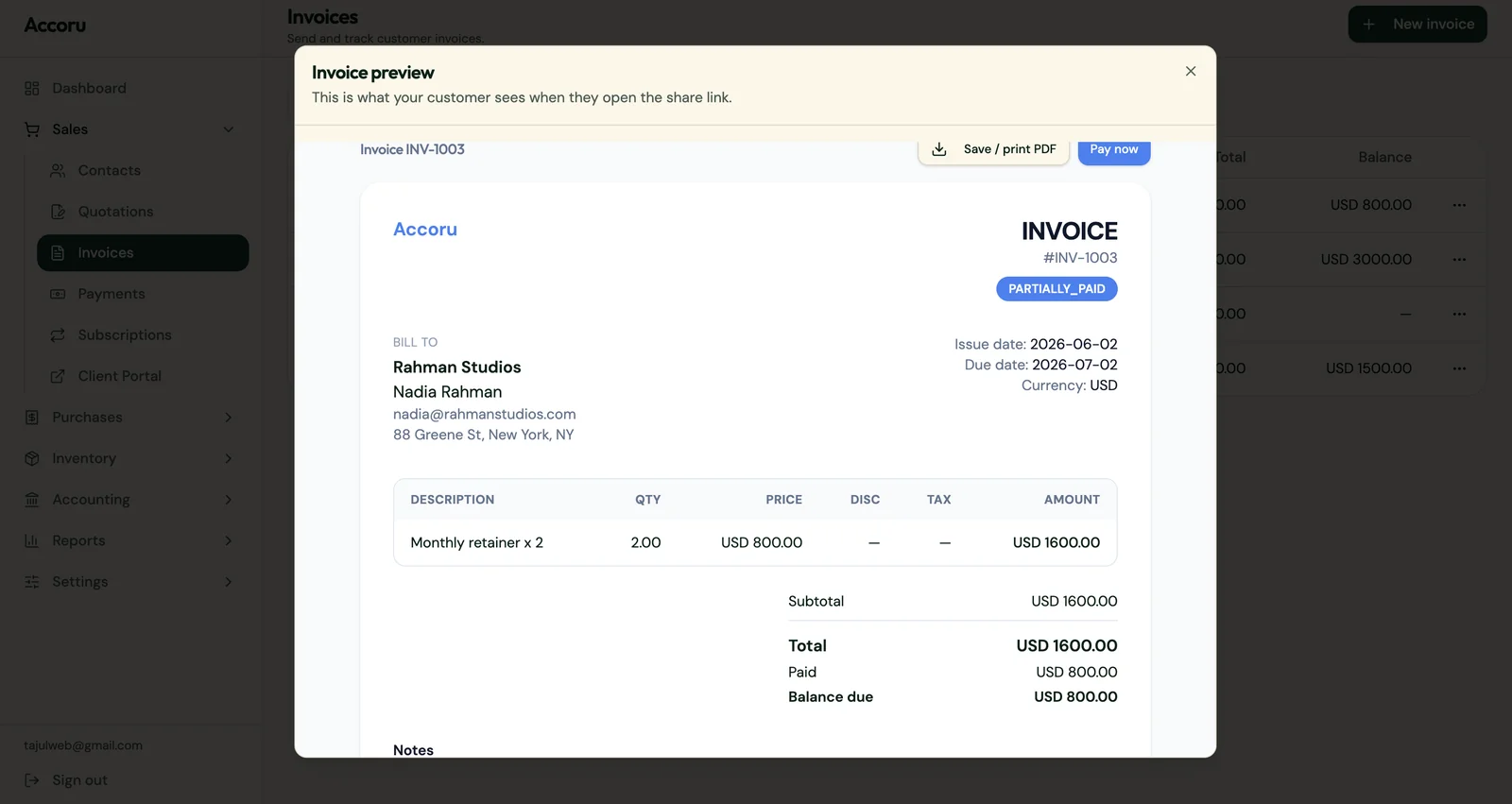
Most payment delays trace back to one of two causes — the invoice was sent late, or the invoice was incomplete.
Incomplete invoices create friction at exactly the wrong moment. A client's accounts payable team cannot process a payment without a PO number that was not included. A tax authority flags a VAT return because invoice numbers are missing. A client queries a line item because the description was too vague. Each gap in the invoice creates a delay — an email exchange, a corrected document, a restarted approval process.
Getting invoices right from the start eliminates this friction entirely. This guide covers everything that belongs on an invoice — legally required, practically necessary, and professionally expected — so every invoice you send is complete, processable, and paid without unnecessary back-and-forth.
The Two Categories of Invoice Information
Invoice requirements fall into two distinct categories that are worth separating from the start.
Legally required information — The fields that tax authorities and commercial law require to be present on a valid invoice. Missing these can make an invoice legally invalid, cause VAT reclaim issues for your client, or create compliance problems for your business. What is legally required varies by jurisdiction — the list below covers the most common requirements across major markets.
Practically required information — The fields that are not always legally mandated but are essential for payment to happen smoothly — client contact details, payment instructions, PO numbers for corporate clients. Technically optional in some legal frameworks, but practically non-negotiable for efficient payment.
Both categories belong on every invoice you send.
The Complete Invoice Checklist
01 — The Word "Invoice"
The document must be clearly labeled as an invoice. This is a legal requirement in most jurisdictions — particularly for VAT-registered businesses — and a practical necessity for accounts payable systems that process documents by type.
Position it prominently at the top of the document. It should be the first thing a reader identifies.
Do not label the document as a bill, a statement, a receipt, or anything else if it is intended as an invoice. These are distinct document types with different legal and accounting treatments.
02 — Your Business Name
Your full legal business name — as registered with the relevant authority in your jurisdiction. For sole traders, this is typically your personal name or your trading name. For limited companies and corporations, it is the registered company name.
If you operate under a trading name that differs from your registered name, include both — the registered name for legal compliance, the trading name for client recognition.
03 — Your Business Address
Your registered business address. This is a legal requirement in most jurisdictions for VAT-registered businesses and limited companies.
For sole traders working from home, check whether your jurisdiction allows a service address — a registered agent address or PO box — instead of your residential address. Many do, particularly for data protection reasons.
04 — Your Contact Details
In addition to your registered address:
- Email address — The email from which you send invoices and to which payment confirmations should be addressed
- Phone number — Optional but useful, particularly for clients who prefer to call with questions rather than email
- Website — Optional, but reinforces professional credibility
Include the contact details through which you actually want clients to reach you about payment — not a generic info@ address if you want payment queries to reach you directly.
05 — Your Business Registration Number
For incorporated businesses — limited companies, LLCs, corporations — the company registration number is a legal requirement on invoices in most jurisdictions. It appears on your certificate of incorporation.
For sole traders and partnerships operating under a registered trading name, check whether a registration number applies in your jurisdiction.
06 — Your VAT, GST, or Sales Tax Registration Number
If your business is registered for VAT, GST, or any equivalent consumption tax, your registration number must appear on every invoice. This is a hard legal requirement — without it, your client cannot reclaim the input tax they paid on their own VAT return, which creates problems for them and reflects poorly on your compliance.
Position the tax registration number clearly — typically near your business name and address at the top of the invoice, or in a dedicated tax information section.
07 — A Unique Invoice Number
Every invoice must have a unique sequential reference number — typically starting from Invoice 001 or a similar format and incrementing with each invoice issued.
The invoice number serves multiple purposes:
- It gives both parties a reference point for any communication about the invoice
- It is required by tax authorities to maintain an auditable invoice record
- It allows accounts payable systems to match invoices to payments
- It prevents duplicate processing of the same invoice
The format is flexible — sequential numbers, year-prefixed numbers (2024-001), client-prefixed numbers (ABC-001) — but the critical requirements are that every invoice has a unique number and the sequence is consistent and auditable.
Do not reuse numbers. Do not skip numbers without a documented reason. Do not reset the sequence mid-year without good cause.
08 — Invoice Date
The date the invoice was created and issued. Not the date work was completed. Not the date the client receives it. The date you issued the invoice.
The invoice date is significant because:
- Payment terms are calculated from the invoice date
- VAT and tax periods are often determined by invoice date
- It establishes the timing of the transaction for accounting purposes
Issue and date invoices on the day they are sent — not backdated to the date work was completed or post-dated to a future date.
09 — Due Date
The specific date by which payment is expected. This should appear explicitly on the invoice — not just payment terms that require calculation.
Both elements are useful together:
- Payment terms: "Net 30 from invoice date"
- Due date: "Payment due: 15 April"
The explicit due date removes any ambiguity and is more likely to prompt timely payment than a payment terms statement alone.
10 — Client Name and Business Name
The full name of the person or organization being billed:
- For individual clients: their full name
- For business clients: the full registered business name
Use the correct legal name — not a nickname, abbreviation, or trading name unless that is how the client is formally identified. An invoice addressed to the wrong entity name can cause processing delays in corporate accounts payable systems.
11 — Client Billing Address
The address to which the invoice is addressed — the client's registered billing address or their accounts payable address. For corporate clients, this may differ significantly from the operational address you deal with day to day.
Confirm the correct billing address at the start of every engagement — ideally during onboarding or contract signing. Using the wrong address wastes time and may cause processing issues.
12 — Client Contact Name or Department
For corporate clients, addressing the invoice to a specific person — the accounts payable manager, the finance director, or the project manager who commissioned the work — helps it reach the right person faster.
Many corporate invoicing processes require a specific contact or department reference. Ask at the start of the engagement whether there is a specific person or department to address invoices to.
13 — Purchase Order Number
For corporate and government clients, a Purchase Order number is often mandatory. Without it, the invoice may be rejected outright or held indefinitely in the accounts payable queue.
At the beginning of any engagement with a larger organization, ask: "Do you require a PO number on invoices?" If yes, obtain the PO number before issuing any invoice and include it prominently — typically near the invoice number or in a dedicated PO reference field.
Never issue an invoice to a corporate client without confirming whether a PO is required. Discovering the requirement after the invoice has been rejected causes delays that could have been avoided.
14 — Line Items
The itemized description of what is being billed — the core of the invoice. Each line item requires:
Description: A specific, clear description of the product or service. Enough detail that the client can match the line item to work they received and authorized.
- Too vague: "Consulting"
- Better: "Brand strategy consulting — March engagement"
- Best: "Brand strategy consulting — discovery, positioning workshop, and recommendations report, 3–21 March"
Quantity: The number of units, hours, days, items, or licenses being billed.
Unit: The unit of measurement — hours, days, items, licenses, words, pages.
Unit rate: The price per unit. For flat-rate project work where quantity is 1, this equals the project total.
Line total: Quantity multiplied by unit rate. Calculated automatically in invoicing software — but stated explicitly on the invoice.
Level of detail: Match the detail level to the billing arrangement and client expectation. A client billed a fixed monthly retainer may need only one line. A client billed on a time-and-materials basis needs itemized hour logs. When in doubt, more detail reduces questions.
15 — Subtotal
The sum of all line item totals before tax and other charges. A clear subtotal gives the client the pre-tax base from which other calculations flow.
16 — Discount (If Applicable)
If a discount has been agreed — a prompt payment discount, a loyalty discount, a volume discount — apply it as a clearly labeled line item after the subtotal.
Format: "Early payment discount (2%): -$40"
Never apply an undisclosed discount — clients should be able to verify that the discounted amount matches what was agreed.
17 — Tax Amount
If your business charges VAT, GST, or sales tax, the tax must appear as a separate line with:
- The tax type (VAT, GST, Sales Tax)
- The applicable rate (20%, 10%, 8.875%)
- The calculated tax amount
For invoices with multiple tax rates — different rates applied to different line items — show each rate separately.
Zero-rated and exempt items: If some line items are zero-rated or exempt, note this explicitly on the relevant lines — "Zero-rated supply" or "Exempt from VAT" — so there is no ambiguity about why tax was not charged.
Reverse charge: For cross-border B2B transactions within the EU and in some other jurisdictions, the reverse charge mechanism shifts VAT liability to the customer. In these cases, note on the invoice: "VAT reverse charge applies — customer to account for VAT."
18 — Total Amount Due
The final amount — subtotal plus tax, minus any discounts. The number the client needs to pay.
Make it prominent. Use bold text, a larger font, or a highlighted box. Accounts payable staff and clients scanning an invoice for the payment amount should find it immediately without reading the entire document.
19 — Currency
State the invoice currency explicitly — particularly if there is any possibility of ambiguity. If you invoice in USD, GBP, EUR, or any other currency, state it clearly:
- "Total: USD 2,500"
- "Amount due: £1,800 GBP"
For international invoices, currency clarity is essential — do not leave the client to assume which currency applies.
20 — Payment Instructions
This is where many invoices fall short. A professional invoice includes everything the client needs to pay — immediately, without asking.
For bank transfer:
- Bank name
- Account holder name
- Account number
- Sort code (UK), BSB (Australia), routing number (US)
- IBAN (international)
- BIC/SWIFT (international)
- Payment reference — typically your invoice number
For online payment:
- A direct payment link — Pay Now button connected to Stripe, PayPal, or your payment gateway
- The payment methods accepted (card, PayPal, bank transfer)
For both: Include both bank transfer details and an online payment link wherever possible. The more payment methods available, the faster payment tends to arrive. Some clients strongly prefer card payment. Others prefer bank transfer. Offering both removes a barrier for each.
Accoru's invoicing includes a Pay Now button on every invoice — connected to Stripe for card payments and PayPal for PayPal payments. Clients pay in one click from the invoice email without needing account details.
21 — Payment Terms
Your payment terms — how long the client has to pay — stated explicitly:
- "Payment due within 30 days of invoice date"
- "Net 14"
- "Due on receipt"
Include late payment terms if applicable — interest rate for late payments, any late fees. State these clearly and consistently on every invoice — not just when you intend to enforce them.
22 — Bank Details for the Correct Account
This sounds obvious but it is a source of payment errors. If you have multiple bank accounts — a GBP account, a USD account, a EUR account — ensure the bank details on the invoice correspond to the currency of the invoice.
If a client sends EUR payment to your GBP account, the bank converts at its own rate — which is typically worse than a specialist rate — and you may incur conversion fees. Matching the currency to the correct account eliminates this.
23 — Notes (Optional)
A brief notes field for any relevant context — a thank you message, special payment instructions, a note about a specific line item, or reference information.
Keep notes brief. The notes field is not the place for contract terms, scope limitations, or extensive explanations. If something requires detailed explanation, address it in a separate communication rather than in the invoice notes.
What Is Different for VAT Invoices
In jurisdictions with VAT — the EU, UK, Australia (GST), and many others — invoices above a certain value threshold must meet additional specific requirements to be considered a valid VAT invoice. A client cannot reclaim input VAT from an invoice that does not meet these requirements.
Key additional requirements for VAT invoices typically include:
- Your VAT registration number (covered above)
- The client's VAT registration number (for B2B supplies)
- The tax point date (the date the supply occurred — which may differ from the invoice date)
- A breakdown of the VAT amount by rate
- Explicit notation for zero-rated, exempt, or reverse charge supplies
Requirements vary by jurisdiction — confirm the specific requirements for your market and the markets you invoice into.
What Is Different for International Invoices
Invoicing international clients adds several elements:
Currency statement: As covered above — explicit currency on every amount.
International banking details: IBAN and BIC/SWIFT in addition to domestic account details.
Exchange rate reference: For invoices where the client will convert currencies, noting the exchange rate at time of invoice (or the agreed rate) is helpful context.
Tax treatment for cross-border services: VAT, GST, and sales tax treatment of cross-border services is complex and varies by jurisdiction. In many cases, B2B services are zero-rated or subject to reverse charge. Confirm the correct treatment for your specific situation with a tax professional.
Language: In some jurisdictions and for some client relationships, an invoice in the client's language is expected or required. Know your client's expectations.
What Is Different for Invoices to Corporate Clients
Corporate clients — larger organizations with formal accounts payable processes — often have additional invoice requirements:
Purchase Order number: Covered above. Always ask before issuing the first invoice.
Supplier code: Some large organizations assign supplier codes to vendors. Include yours on invoices to these clients.
Specific billing address: Corporate billing addresses are often different from operational addresses. Confirm and use the correct one.
Invoice submission process: Some corporate clients require invoices to be submitted through a supplier portal rather than by email. Confirm the correct submission process at the start of the engagement.
Invoice approval contacts: Know who approves invoices internally at the client and address accordingly.
Failing to follow corporate invoicing requirements — particularly the PO number — is one of the most common causes of extended payment delays for businesses working with larger clients.
The Invoice Review Checklist
Before sending any invoice, review it against this checklist:
Your details:
- ☐ Business name correct
- ☐ Address correct
- ☐ Contact details correct
- ☐ Company registration number included (if required)
- ☐ VAT/GST registration number included (if applicable)
Invoice identification:
- ☐ Labeled "Invoice"
- ☐ Unique invoice number assigned
- ☐ Invoice date correct
- ☐ Due date stated explicitly
Client details:
- ☐ Client name correct (legal name)
- ☐ Billing address correct
- ☐ Contact name included
- ☐ PO number included (if required)
Line items:
- ☐ Each item clearly described
- ☐ Quantities and rates correct
- ☐ Line totals correct
Totals and tax:
- ☐ Subtotal correct
- ☐ Tax rate and amount correct (if applicable)
- ☐ Discount applied correctly (if applicable)
- ☐ Total amount due correct and prominent
Payment information:
- ☐ Currency stated
- ☐ Bank details complete and correct
- ☐ Payment link included (if applicable)
- ☐ Payment terms stated
- ☐ Reference for payment stated
A three-minute pre-send review against this checklist prevents payment delays caused by missing or incorrect information.
When to Use a Simplified Invoice
Many jurisdictions allow a simplified invoice format — with fewer required fields — for lower-value transactions. In the UK, for example, a simplified VAT invoice can be used for supplies under £250 and does not need to include the customer's name and address or a unit price.
Simplified invoices are useful for retail businesses and service providers processing high volumes of low-value transactions. For most professional service businesses invoicing clients for meaningful amounts, a full invoice with all required fields is the appropriate format.
Summary
A complete invoice is the foundation of getting paid on time. Missing or incorrect information — a PO number, a VAT number, an ambiguous line item description, missing bank details — creates friction that delays payment unnecessarily.
The non-negotiables for every invoice:
- The word Invoice, prominently labeled
- Your business name, address, registration numbers
- A unique invoice number and invoice date
- An explicit due date
- Client name, billing address, and PO number if required
- Itemized line items with clear descriptions, quantities, rates, and totals
- Tax information if applicable
- Total amount due — prominent and unambiguous
- Complete payment instructions — bank details and payment link
- Payment terms
Build these elements into your invoice template once — in invoicing software that populates them automatically — and every invoice you send will be complete without reviewing a checklist every time.
Frequently Asked Questions
Q: What is legally required on an invoice? A: Legal requirements vary by jurisdiction and business type. For VAT-registered businesses in the UK and EU, a valid VAT invoice must include: the word invoice, a unique sequential number, invoice date, tax point date, your name and address, your VAT registration number, the customer's name and address, a description of the supply, the quantity and rate, the VAT rate and amount, and the total including VAT. For non-VAT-registered businesses, requirements are less prescriptive but typically include your business name, address, invoice number, date, and payment details.
Q: Does every invoice need a VAT number? A: Only if your business is VAT registered. If you are below the VAT registration threshold in your jurisdiction, you do not charge VAT and do not need to include a VAT number. If you are VAT registered, your VAT number must appear on every invoice — its absence makes the invoice an invalid VAT invoice and prevents your client from reclaiming input tax.
Q: What is a PO number and do I need one on my invoices? A: A Purchase Order number is a reference number issued by the client's purchasing or procurement department authorizing the purchase. Many corporate and government clients require it on supplier invoices — without it, the invoice cannot be processed. Ask at the start of any engagement with a larger organization whether they require a PO number and obtain it before issuing your first invoice.
Q: How specific do line item descriptions need to be? A: Specific enough that the client can match each line to work they received and authorized without needing to ask. The appropriate level of detail depends on your billing arrangement — a flat monthly retainer might need only a brief description, while time-and-materials billing needs more detailed line items. When in doubt, err on the side of more detail rather than less. Vague descriptions are one of the most common causes of invoice queries that delay payment.
Q: Can I send an invoice without the client's address? A: For VAT invoices, the customer's name and address are typically required. For non-VAT invoices, it depends on your jurisdiction. Practically, including the client's billing address on every invoice — regardless of legal requirement — makes the invoice more professional and easier to process. It is always better to include it.
Q: What should I do if I forgot to include something on a sent invoice? A: Issue a corrected invoice with a new invoice number, a reference to the original invoice number, and a brief note explaining what was corrected. In many jurisdictions, you should also issue a credit note against the original before issuing the corrected version. Notify the client that a corrected invoice is being sent and explain what changed.
Accoru's invoicing includes all required fields by default — your business details, VAT number, invoice number, line items, tax calculations, and payment links — so every invoice you send is complete without a manual checklist.